> ## Documentation Index
> Fetch the complete documentation index at: https://hoopdev-docs-improve-idp-sso-pages.mintlify.site/llms.txt
> Use this file to discover all available pages before exploring further.
# Guardrails Configuration
> Create and manage pattern-based rules to block dangerous queries
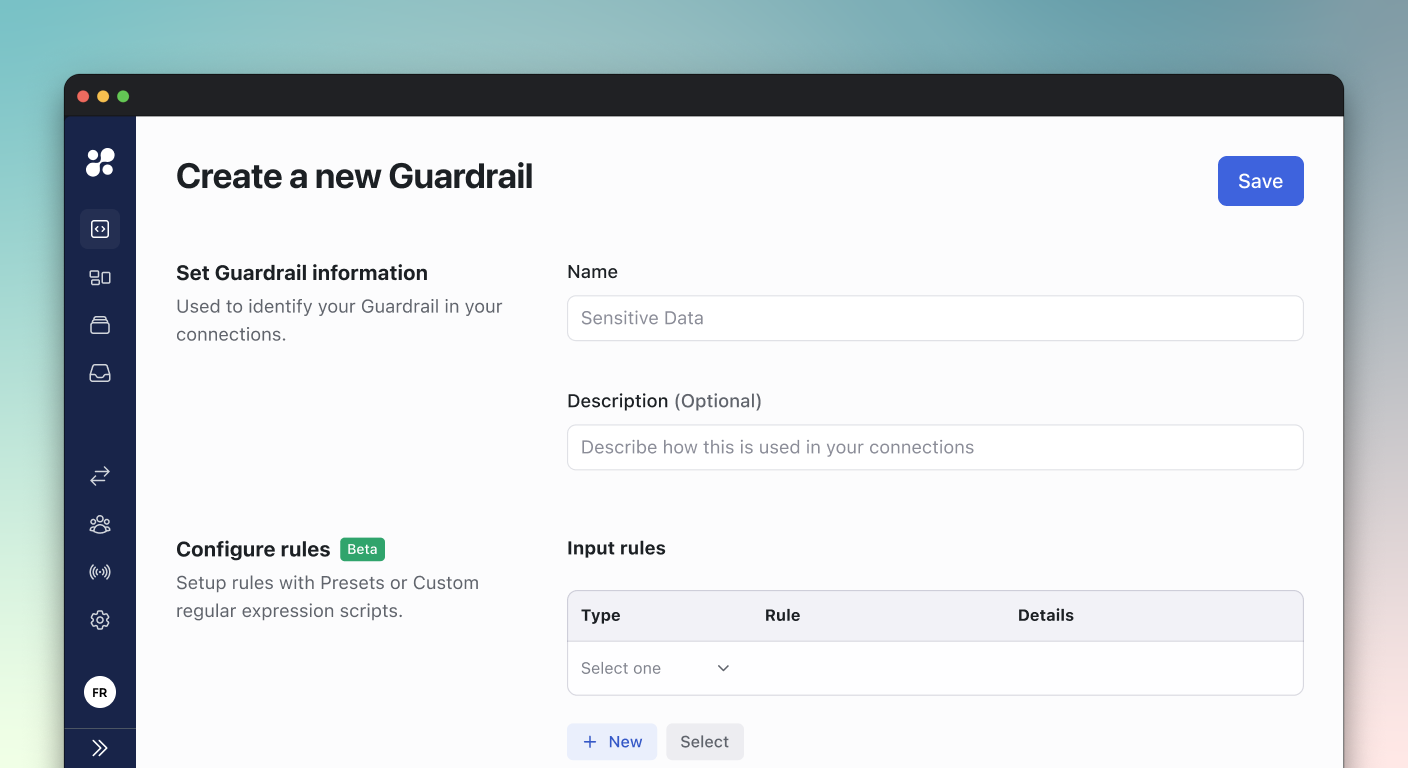
 Guardrails use pattern matching to evaluate queries and block dangerous operations before they execute. This page covers configuration options and rule syntax.
For an introduction to what Guardrails do and common use cases, see [Guardrails Overview](/learn/features/guardrails).
***
## Creating a Guardrail
Go to **Manage > Guardrails** in the sidebar
Click **Create New Guardrail** in the top-right corner
* **Name:** A short identifier (e.g., `block-ddl`, `read-only-mode`)
* **Description:** Explain what this guardrail protects against
Configure Input Rules and/or Output Rules (see below)
Select which connections this guardrail applies to
Click **Save** to activate the guardrail
***
## Rule Configuration
### Input Rules
Input rules evaluate queries **before** they execute. Use these to block dangerous commands.
| Field | Description | Example |
| ----------- | ------------------------------- | ----------------------------- |
| **Pattern** | Regex pattern to match | `(?i)DROP\s+TABLE` |
| **Action** | What to do when pattern matches | Block, Warn, Require Approval |
| **Message** | Error message shown to user | `DDL commands are blocked` |
### Output Rules
Output rules evaluate query results **after** execution. Use these to filter or redact output.
| Field | Description | Example |
| --------------- | -------------------------------- | ----------------------------- |
| **Pattern** | Regex pattern to match in output | `\b\d{3}-\d{2}-\d{4}\b` (SSN) |
| **Action** | What to do when pattern matches | Redact, Block, Warn |
| **Replacement** | Text to replace matches with | `[REDACTED]` |
For data masking that automatically detects PII, see [Live Data Masking](/learn/features/live-data-masking) instead.
***
## Pattern Syntax
Guardrails use **regular expressions** (regex) for pattern matching. Here are the most useful patterns:
### Basic Syntax
| Syntax | Meaning | Example |
| --------- | ----------------------- | ------------------------------------------- |
| `(?i)` | Case-insensitive | `(?i)drop` matches `DROP`, `Drop`, `drop` |
| `\s+` | One or more whitespace | `DROP\s+TABLE` matches `DROP TABLE` |
| `\s*` | Zero or more whitespace | `DROP\s*TABLE` matches `DROPTABLE` too |
| `\b` | Word boundary | `\bDROP\b` won't match `BACKDROP` |
| `^` | Start of string | `^SELECT` only matches SELECT at start |
| `$` | End of string | `;\s*$` matches trailing semicolon |
| `.*` | Any characters | `SELECT.*FROM` matches anything between |
| `(?!...)` | Negative lookahead | `(?!.*WHERE)` means "not followed by WHERE" |
### Common Patterns
**Block UPDATE without WHERE:**
```regex theme={null}
(?i)^\s*UPDATE\s+\w+\s+SET\s+(?!.*WHERE)
```
**Block DELETE without WHERE:**
```regex theme={null}
(?i)^\s*DELETE\s+FROM\s+\w+(?!.*WHERE)
```
**Block all DDL:**
```regex theme={null}
(?i)^\s*(DROP|CREATE|ALTER|TRUNCATE)\s+(TABLE|DATABASE|INDEX|SCHEMA|VIEW)
```
**Block SELECT \* on specific tables:**
```regex theme={null}
(?i)SELECT\s+\*\s+FROM\s+(users|orders|transactions)
```
**Require LIMIT clause:**
```regex theme={null}
(?i)SELECT\s+(?!.*\bLIMIT\b).*FROM
```
### Testing Patterns
Before deploying a pattern, test it at [regex101.com](https://regex101.com):
1. Select **Flavor: ECMAScript** (JavaScript)
2. Paste your pattern in the **Regular Expression** field
3. Enter test queries in the **Test String** field
4. Verify matches highlight correctly
***
## Actions
### Block
Prevents the query from executing and returns an error.
**Use when:** The operation should never be allowed (e.g., `DROP TABLE` in production)
**User sees:**
```
Error: Guardrail violation
Rule: block-ddl
Message: DDL commands are blocked in production
```
### Warn
Allows the query but shows a warning message.
**Use when:** You want to educate users without blocking work (e.g., missing LIMIT)
**User sees:**
```
Warning: Consider adding a LIMIT clause to prevent large result sets
Query executed successfully.
```
### Require Approval
Blocks the query until an approver approves it.
**Use when:** Some queries need human review before execution (e.g., bulk updates)
**User sees:**
```
This query requires approval.
Waiting for approval at https://use.hoop.dev/access-requests/abc123...
```
Require Approval uses the same workflow as [Action Access Requests](/learn/features/access-requests/action).
***
## Connection Assignment
Each guardrail can be assigned to multiple connections. You can also have multiple guardrails on a single connection.
### Assignment Options
| Option | Description |
| ------------------------ | ---------------------------------------------- |
| **Specific connections** | Select individual connections from the list |
| **All connections** | Apply to every connection in your organization |
| **Connection tags** | Apply to connections matching specific tags |
### Evaluation Order
When multiple guardrails apply to a connection, they are evaluated in order of priority:
1. **Priority 1** (highest) evaluated first
2. First matching rule determines the action
3. If no rules match, query is allowed
To set priority:
1. Go to **Manage > Guardrails**
2. Drag guardrails to reorder them
3. Higher position = higher priority
***
## Environment Variables
These environment variables affect guardrails behavior on the gateway:
| Variable | Description | Default |
| ---------------------- | ------------------------------------------- | ------- |
| `GUARDRAILS_ENABLED` | Enable/disable guardrails globally | `true` |
| `GUARDRAILS_LOG_LEVEL` | Logging verbosity (`debug`, `info`, `warn`) | `info` |
***
## Monitoring Guardrails
### Viewing Blocked Queries
1. Go to **Sessions** in the sidebar
2. Filter by **Status: Blocked**
3. Click a session to see details
Each blocked session shows:
* The query that was blocked
* Which guardrail and rule triggered
* The error message
* User and timestamp
### Audit Log
All guardrail evaluations are logged:
* **Blocked queries** - Logged with full query text
* **Warnings** - Logged with warning message
* **Approval requests** - Logged with request status
Access audit logs in **Sessions** or export via the API.
***
## Best Practices
Use Warn mode first to understand impact before blocking
Apply guardrails to test connections before production
Use precise patterns to avoid false positives
Write clear descriptions explaining why each rule exists
### Pattern Guidelines
1. **Always use `(?i)`** for case-insensitive matching
2. **Use `\b` for word boundaries** to avoid partial matches
3. **Use `^\s*`** to allow leading whitespace
4. **Test edge cases** like multi-line queries and comments
5. **Keep patterns simple** - complex regex is hard to maintain
***
## Troubleshooting
### Pattern Not Matching
**Check:**
1. Test the pattern at [regex101.com](https://regex101.com) with the exact query
2. Verify case sensitivity (add `(?i)` if needed)
3. Check for leading/trailing whitespace in the query
### Too Many False Positives
**Fix:**
1. Make the pattern more specific
2. Add word boundaries (`\b`)
3. Use negative lookahead for exceptions
**Example:** Pattern `DROP` blocks `DROP_SHIPPED_ITEMS` table name
**Fix:** `(?i)^\s*DROP\s+(TABLE|DATABASE)` only matches DDL commands
### Performance Issues
If queries are slow:
1. Reduce the number of rules per connection
2. Simplify complex regex patterns
3. Avoid patterns with excessive backtracking (e.g., `.*.*.*`)
***
## Related
Learn what guardrails do and see common recipes
Configure automatic PII detection and masking
Configure the "Require Approval" action
Control who can access which connections
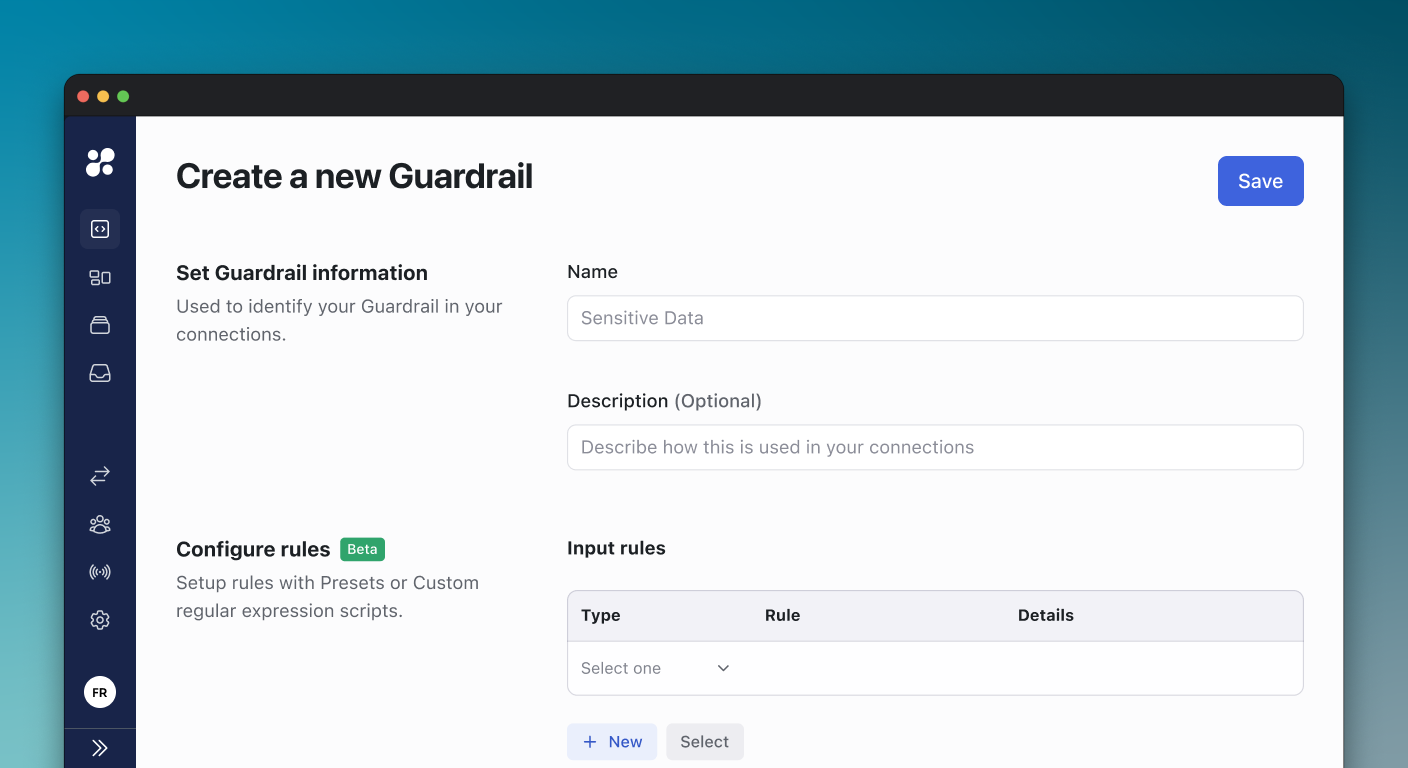
Guardrails use pattern matching to evaluate queries and block dangerous operations before they execute. This page covers configuration options and rule syntax.
For an introduction to what Guardrails do and common use cases, see [Guardrails Overview](/learn/features/guardrails).
***
## Creating a Guardrail
Go to **Manage > Guardrails** in the sidebar
Click **Create New Guardrail** in the top-right corner
* **Name:** A short identifier (e.g., `block-ddl`, `read-only-mode`)
* **Description:** Explain what this guardrail protects against
Configure Input Rules and/or Output Rules (see below)
Select which connections this guardrail applies to
Click **Save** to activate the guardrail
***
## Rule Configuration
### Input Rules
Input rules evaluate queries **before** they execute. Use these to block dangerous commands.
| Field | Description | Example |
| ----------- | ------------------------------- | ----------------------------- |
| **Pattern** | Regex pattern to match | `(?i)DROP\s+TABLE` |
| **Action** | What to do when pattern matches | Block, Warn, Require Approval |
| **Message** | Error message shown to user | `DDL commands are blocked` |
### Output Rules
Output rules evaluate query results **after** execution. Use these to filter or redact output.
| Field | Description | Example |
| --------------- | -------------------------------- | ----------------------------- |
| **Pattern** | Regex pattern to match in output | `\b\d{3}-\d{2}-\d{4}\b` (SSN) |
| **Action** | What to do when pattern matches | Redact, Block, Warn |
| **Replacement** | Text to replace matches with | `[REDACTED]` |
For data masking that automatically detects PII, see [Live Data Masking](/learn/features/live-data-masking) instead.
***
## Pattern Syntax
Guardrails use **regular expressions** (regex) for pattern matching. Here are the most useful patterns:
### Basic Syntax
| Syntax | Meaning | Example |
| --------- | ----------------------- | ------------------------------------------- |
| `(?i)` | Case-insensitive | `(?i)drop` matches `DROP`, `Drop`, `drop` |
| `\s+` | One or more whitespace | `DROP\s+TABLE` matches `DROP TABLE` |
| `\s*` | Zero or more whitespace | `DROP\s*TABLE` matches `DROPTABLE` too |
| `\b` | Word boundary | `\bDROP\b` won't match `BACKDROP` |
| `^` | Start of string | `^SELECT` only matches SELECT at start |
| `$` | End of string | `;\s*$` matches trailing semicolon |
| `.*` | Any characters | `SELECT.*FROM` matches anything between |
| `(?!...)` | Negative lookahead | `(?!.*WHERE)` means "not followed by WHERE" |
### Common Patterns
**Block UPDATE without WHERE:**
```regex theme={null}
(?i)^\s*UPDATE\s+\w+\s+SET\s+(?!.*WHERE)
```
**Block DELETE without WHERE:**
```regex theme={null}
(?i)^\s*DELETE\s+FROM\s+\w+(?!.*WHERE)
```
**Block all DDL:**
```regex theme={null}
(?i)^\s*(DROP|CREATE|ALTER|TRUNCATE)\s+(TABLE|DATABASE|INDEX|SCHEMA|VIEW)
```
**Block SELECT \* on specific tables:**
```regex theme={null}
(?i)SELECT\s+\*\s+FROM\s+(users|orders|transactions)
```
**Require LIMIT clause:**
```regex theme={null}
(?i)SELECT\s+(?!.*\bLIMIT\b).*FROM
```
### Testing Patterns
Before deploying a pattern, test it at [regex101.com](https://regex101.com):
1. Select **Flavor: ECMAScript** (JavaScript)
2. Paste your pattern in the **Regular Expression** field
3. Enter test queries in the **Test String** field
4. Verify matches highlight correctly
***
## Actions
### Block
Prevents the query from executing and returns an error.
**Use when:** The operation should never be allowed (e.g., `DROP TABLE` in production)
**User sees:**
```
Error: Guardrail violation
Rule: block-ddl
Message: DDL commands are blocked in production
```
### Warn
Allows the query but shows a warning message.
**Use when:** You want to educate users without blocking work (e.g., missing LIMIT)
**User sees:**
```
Warning: Consider adding a LIMIT clause to prevent large result sets
Query executed successfully.
```
### Require Approval
Blocks the query until an approver approves it.
**Use when:** Some queries need human review before execution (e.g., bulk updates)
**User sees:**
```
This query requires approval.
Waiting for approval at https://use.hoop.dev/access-requests/abc123...
```
Require Approval uses the same workflow as [Action Access Requests](/learn/features/access-requests/action).
***
## Connection Assignment
Each guardrail can be assigned to multiple connections. You can also have multiple guardrails on a single connection.
### Assignment Options
| Option | Description |
| ------------------------ | ---------------------------------------------- |
| **Specific connections** | Select individual connections from the list |
| **All connections** | Apply to every connection in your organization |
| **Connection tags** | Apply to connections matching specific tags |
### Evaluation Order
When multiple guardrails apply to a connection, they are evaluated in order of priority:
1. **Priority 1** (highest) evaluated first
2. First matching rule determines the action
3. If no rules match, query is allowed
To set priority:
1. Go to **Manage > Guardrails**
2. Drag guardrails to reorder them
3. Higher position = higher priority
***
## Environment Variables
These environment variables affect guardrails behavior on the gateway:
| Variable | Description | Default |
| ---------------------- | ------------------------------------------- | ------- |
| `GUARDRAILS_ENABLED` | Enable/disable guardrails globally | `true` |
| `GUARDRAILS_LOG_LEVEL` | Logging verbosity (`debug`, `info`, `warn`) | `info` |
***
## Monitoring Guardrails
### Viewing Blocked Queries
1. Go to **Sessions** in the sidebar
2. Filter by **Status: Blocked**
3. Click a session to see details
Each blocked session shows:
* The query that was blocked
* Which guardrail and rule triggered
* The error message
* User and timestamp
### Audit Log
All guardrail evaluations are logged:
* **Blocked queries** - Logged with full query text
* **Warnings** - Logged with warning message
* **Approval requests** - Logged with request status
Access audit logs in **Sessions** or export via the API.
***
## Best Practices
Use Warn mode first to understand impact before blocking
Apply guardrails to test connections before production
Use precise patterns to avoid false positives
Write clear descriptions explaining why each rule exists
### Pattern Guidelines
1. **Always use `(?i)`** for case-insensitive matching
2. **Use `\b` for word boundaries** to avoid partial matches
3. **Use `^\s*`** to allow leading whitespace
4. **Test edge cases** like multi-line queries and comments
5. **Keep patterns simple** - complex regex is hard to maintain
***
## Troubleshooting
### Pattern Not Matching
**Check:**
1. Test the pattern at [regex101.com](https://regex101.com) with the exact query
2. Verify case sensitivity (add `(?i)` if needed)
3. Check for leading/trailing whitespace in the query
### Too Many False Positives
**Fix:**
1. Make the pattern more specific
2. Add word boundaries (`\b`)
3. Use negative lookahead for exceptions
**Example:** Pattern `DROP` blocks `DROP_SHIPPED_ITEMS` table name
**Fix:** `(?i)^\s*DROP\s+(TABLE|DATABASE)` only matches DDL commands
### Performance Issues
If queries are slow:
1. Reduce the number of rules per connection
2. Simplify complex regex patterns
3. Avoid patterns with excessive backtracking (e.g., `.*.*.*`)
***
## Related
Learn what guardrails do and see common recipes
Configure automatic PII detection and masking
Configure the "Require Approval" action
Control who can access which connections